
Point One Navigation adds Network RTK delivery to its corrections network
PR Newswire
SAN FRANCISCO, Aug. 5, 2026
SAN FRANCISCO, Aug. 5, 2026 /PRNewswire/ — Point One Navigation, a precision location platform for autonomous and location-dependent systems, today launched Network RTK delivery for True RTK, its flagship real-time kinematic correction service. Customers can now configure any device for single-baseline or Network RTK delivery under the same True RTK license, choosing per device or per deployment without adopting a second product or negotiating a new contract.
The addition of Network RTK leverages Point One’s existing global network of base stations while supplying a new corrections delivery mechanism for customers. Single-baseline RTK, which pairs a rover with its nearest physical base station, has long been the default for applications that need deterministic, traceable precision. Network RTK, which calculates a geometric correction from multiple stations at the time of use, is preferred by OEMs whose hardware or field conditions benefit from a network-modeled solution instead. Point One now delivers both from the same platform and the same station network.
How it works
Point One Network RTK delivers Virtual Reference Station (VRS) corrections over standard RTCM. When a rover connects, Point One’s correction server selects surrounding base stations, ingests their raw observables, and generates a synthesized correction stream delivered as if it came from a single nearby base. Any RTK-capable receiver supporting standard RTCM is compatible, no hardware modification required.
Customers choose based on operational priorities: single-baseline for full traceability and deterministic replayability; Network RTK for automatic multi-station redundancy and faster convergence on lower-cost receivers. For teams managing fleets at scale, Point One’s GraphQL API supports flexible correction profiles, including automatic fallback from single-baseline to Network RTK when a station goes offline. No manual intervention required, define the rules once, and the network handles the rest.
“Single-baseline and Network RTK solve different problems, and most vendors have made customers pick one,” said Aaron Nathan, CEO of Point One Navigation. “True RTK doesn’t force that choice anymore. Both delivery modes run on the same station network, so the decision comes down to what our customer’s workflow actually needs, not which product they happen to be locked into.”
The Point One difference
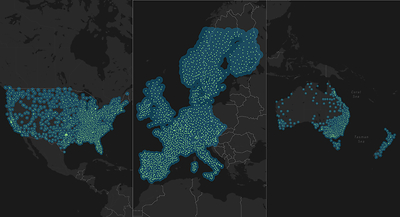
Most Network RTK services use algorithmic interpolation to extend coverage across sparse station networks. Point One has built a dense network of base stations at 30–40 km average inter-station spacing. Point One’s stations sample the atmosphere at the resolution it physically varies. The result is Network RTK operates over the shortest baselines with real observations, instead of estimates across gaps.
Both delivery modes within True RTK share the same 1-2 cm accuracy and near-instantaneous Fix times. The difference is architectural. A single-baseline receiver typically holds Fix out to about 50 kilometers from its base station; if that station goes down, the receiver can drop briefly into Float while it reconnects to the next-nearest one. Network RTK is far less disrupted by a single station outage and extends usable range to 60 to 70 kilometers, which also helps lower-cost receivers that lose accuracy past 25 kilometers on a single baseline. That extended range depends entirely on the density of the underlying station network: Point One’s stations sit at sub-40-kilometer spacing, which is what the ranges above are measured against. Delivery mode is set at the device level through the Point One Device Management API, with no change to existing True RTK provisioning.
What customers are saying
Emlid, which builds GNSS receivers for survey and mapping applications, has run Network RTK since Point One’s early access period opened in January 2026.
“Network RTK gives our customers the coverage they need to get centimeter-level positioning up and running quickly, without having to deploy their own base station infrastructure. It’s exactly the kind of accessible, scalable correction service the survey and mapping industry has needed.” — Igor Vereninov, CEO, Emlid
Network RTK is available today, with coverage including the United States, United Kingdom, EU, Australia, and New Zealand, with coverage continuing to expand alongside the company’s roughly 100-stations-per-week deployment pace. Customers have a choice between single-baseline and Network RTK on the same infrastructure, same API, same hardware, same price. A free trial is available at pointonenav.com. Existing customers can activate Network RTK via the Point One API or web interface with no hardware or pricing changes.
About Point One Navigation
Point One Navigation is the precision location platform for companies building autonomous and location-dependent systems at scale. Leaders in robotics and autonomy rely on Point One for production deployments spanning autonomous mowers, last-mile delivery vehicles, and E-911 location. Point One’s fully owned and operated global corrections network with over 4,000 professionally built and managed base stations, operates at sub-40 km inter-station spacing, making it the densest professionally-managed GNSS reference network in the world. The platform integrates an RTK corrections network, sensor-fusion positioning engine software, and a GraphQL API for fleet management and observability. Founded in 2017 and headquartered in San Francisco. Learn more at pointonenav.com
Media Contact:
Dahn Pratt
press@pointonenav.com

 View original content to download multimedia:https://www.prnewswire.com/news-releases/point-one-navigation-adds-network-rtk-delivery-to-its-corrections-network-302842795.html
SOURCE Point One Navigation


