A registered human RCT reports significantly increased fecal microplastic excretion and lower urinary plasticizer biomarkers versus placebo.
XIAMEN, FUJIAN, CHINA, October 28, 2026 /EINPresswire.com/ — Fabiotics today announced that complete results from a Fudan-sponsored randomized controlled trial of its lead probiotic strain DePlastox™ PD01 (Lactiplantibacillus plantarum) — the first registered human RCT to report significantly increased fecal microplastic excretion and reduced urinary plasticizer biomarkers — are now public as a preprint on medRxiv (DOI: 10.64898/2026.08.12.26360001; posted October 21, 2026; ClinicalTrials.gov NCT07416214). Microplastic clearance was previously demonstrated in a peer-reviewed mouse study in npj Science of Food (Nature Portfolio).
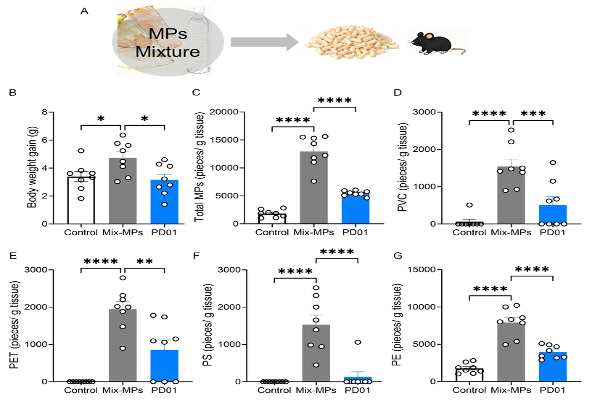
The mouse study, published August 4, 2026 (DOI: 10.1038/s41538-026-01045-6), reports that PD01-treated mice showed a 57.83% reduction in total gut microplastic load and a 91.35% reduction in the polystyrene (PS) fraction compared with controls, in a mixed-microplastic dietary model simulating real-world exposure. The work was co-authored by Fabiotics’ own research team with researchers at Fudan University, the CAS Institute of Urban Environment, and the National Health Commission (NHC) Specialty Laboratory of Food-Safety Risk Assessment and Standard Development, and characterizes the human-sourced strain, isolated from a donor with naturally high microplastic excretion.
The trial, sponsored by Fudan University, was a randomized, double-blind, placebo-controlled study that enrolled 96 participants and imposed no dietary or behavioral restrictions. Over six weeks, it measured fecal microplastics and urinary plasticizer metabolites — recognized exposure biomarkers. The completed analysis (medRxiv; preprint, not yet peer-reviewed) reports significantly increased fecal excretion of total microplastics at weeks 3 and 6, and lower urinary plasticizer biomarkers by week 6 — all four measured metabolites down versus placebo (P < 0.05) — the microplastic category's only published human RCT data to date, with no adverse events reported in the PD01 group. A peer-reviewed manuscript is in preparation. The preprint describes this as the first clinical evidence that human plastic burden can be lowered without dietary or behavioral restrictions. That record reflects a research-driven model: in-house screening backed by university resources, turning frontier science into deployable strains.
Can probiotics reduce microplastics?
In mice, PD01 reduced intestinal microplastic retention; in humans, trial data point the same direction: significantly increased fecal microplastic excretion and reduced urinary plasticizer metabolites versus placebo (preprint, not yet peer-reviewed). Unlike most commercial probiotic strains, isolated from fermented foods, dairy, or soil, PD01 was isolated from the gut microbiome of a donor with naturally high microplastic excretion. In laboratory tests, PD01 adsorbed microplastics and reduced translocation in model systems.
“Microplastics have been found in human blood, placenta, and lungs. The question is whether nature offers a way to clear them. We search for that answer in microorganisms of human origin — and hold it to the highest scientific standard,” said Song Huang, co-founder and CEO of Fabiotics and former Scientist and Global Technical Lead for Microbial Strain R&D Programs at DuPont.
For brand R&D teams, formulators, and contract manufacturers evaluating ingredients for supplements and functional foods, the combined record is built to shorten due diligence: an open-access npj Science of Food study (Nature Portfolio), plus a registered trial with a ClinicalTrials.gov record and a citable preprint.
Full paper: DOI 10.1038/s41538-026-01045-6; the trial record and preprint on ClinicalTrials.gov and medRxiv. Brand and manufacturer inquiries: songhuang@fabioticsgroup.com
About Fabiotics
Fabiotics is a research-driven biotech company co-founded by Song Huang, former Scientist and Global Technical Lead for Microbial Strain R&D Programs at DuPont. Working with Fudan University, the Chinese Academy of Sciences’ Institute of Urban Environment, and the NHC Specialty Laboratory, it screens strains from a 138-donor human microplastic-exposure database, and has developed two generations of microplastic-targeted probiotic strains. Its lead ingredient, DePlastox™ PD01 — which reduced various microplastic types in the gut by up to 91.35% in a peer-reviewed mouse study — is deposited as CGMCC No. 30386 and protected by granted Chinese patent ZL 2024 1 1547090.6 (PCT/CN2025/102722 pending). More: fabioticsgroup.com
Song Huang
Fabiotics
+86 185 1658 7931
Visit us on social media:
LinkedIn
Legal Disclaimer:
EIN Presswire provides this news content “as is” without warranty of any kind. We do not accept any responsibility or liability
for the accuracy, content, images, videos, licenses, completeness, legality, or reliability of the information contained in this
article. If you have any complaints or copyright issues related to this article, kindly contact the author above.

Media gallery